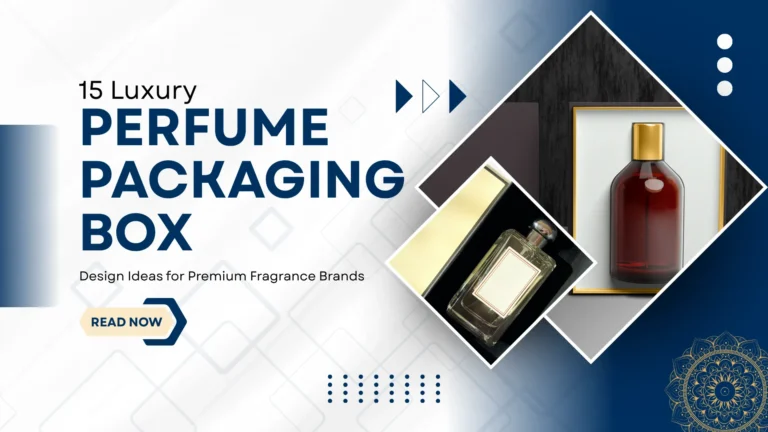
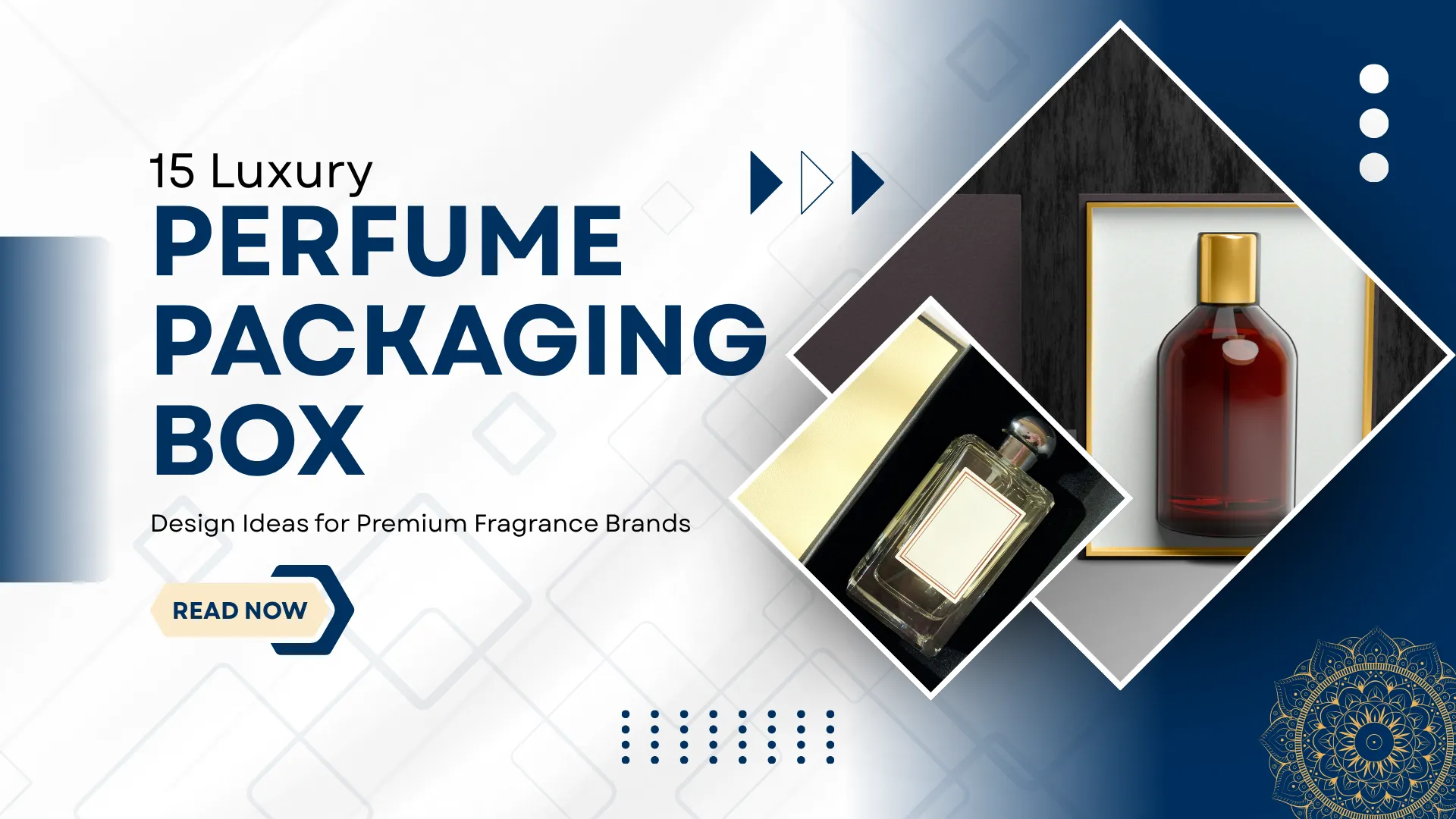
Perfume is an emotional purchase. Before a customer ever smells the fragrance inside, they judge it by the box it comes in. A well-designed perfume box signals quality, builds trust and makes the product feel worth its price. A poorly designed one, no matter how good the fragrance, can make even a premium scent look ordinary.
This is why perfume packaging box design ideas matter so much to fragrance brands, whether you’re a new indie perfumer or an established cosmetic company launching a new line. Packaging affects shelf appeal, protects a fragile glass bottle during transit, and shapes the entire unboxing experience that customers now expect to photograph and share online.
In this guide, we’ll walk through 15 luxury perfume packaging box design ideas, the materials and finishes that bring them to life, and practical advice on choosing the right perfume packaging box manufacturer. Whether you’re exploring perfume packaging ideas for a new launch or comparing custom perfume packaging boxes for an existing brand, this article — put together with input from the packaging team at Packology — is meant to give you a clear, practical starting point.
Why Packaging Design Matters for Luxury Perfume Brands
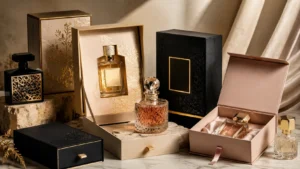
Short answer: Luxury perfume packaging shapes how customers perceive value before they even open the bottle. Strong box design supports brand positioning, protects a fragile product, encourages gifting, and turns a simple purchase into a memorable unboxing experience that customers want to share.
Perfume is often sold on emotion and identity rather than pure function. A customer buying a fragrance is also buying a feeling — confidence, elegance, nostalgia, or luxury. Packaging is one of the fastest ways to communicate that feeling before a single spray.
A few reasons packaging design deserves serious attention:
- Brand positioning: Rigid, well-finished boxes instantly suggest a premium fragrance, while flimsy packaging can undercut even a genuinely high-quality scent.
- Perceived value: Thoughtful structural design and finishing techniques justify a higher price point in the customer’s mind.
- Differentiation: With hundreds of fragrances competing for shelf space, distinctive perfume box packaging helps a product stand out at first glance.
- Gifting appeal: Perfume is one of the most gifted beauty products, so packaging needs to look presentation-ready without extra wrapping.
- Customer experience: From the moment the box is lifted off a shelf to the moment it’s opened at home, packaging shapes how the product feels to use.
15 Luxury Perfume Packaging Box Design Ideas
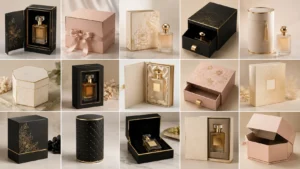
Below are 15 proven perfume packaging box design ideas, ranging from structural styles to finishing details, that premium fragrance brands can use as inspiration for their next packaging project.
1. Magnetic Closure Rigid Perfume Boxes
Magnetic closure boxes use a hidden magnet in the lid that clicks shut with a satisfying, secure snap. This small mechanical detail creates an immediate sense of quality the moment a customer touches the box.
These rigid perfume boxes are ideal for flagship fragrances, gifting collections and retail display, since the closure feels premium and protects the bottle from accidental opening in transit. Brands can pair the magnetic lid with foil-stamped logos, embossed patterns or a wraparound sleeve for extra branding real estate.
2. Drawer-Style Perfume Packaging Boxes
Drawer-style, or sleeve-and-tray, packaging involves an inner tray that slides out of an outer sleeve, revealing the bottle in stages. This slow reveal builds anticipation and turns unboxing into a small ritual.
The sliding tray also creates space for custom foam or fabric inserts that cradle the bottle securely. Drawer-style boxes work particularly well for limited editions and gift sets, where the added structure justifies a slightly higher packaging cost.
3. Book-Style Rigid Perfume Boxes
Book-style boxes open like a hardcover book, with the bottle nested inside and often a printed inner panel that tells the brand’s story, fragrance notes, or inspiration behind the scent.
This format works well for storytelling-driven brands and premium collections where the packaging itself becomes part of the product experience. The flat, book-like shape also displays beautifully on a shelf, standing upright like a small library of scents.
4. Two-Piece Lid and Base Perfume Boxes
The two-piece lid-and-base structure is a packaging classic for good reason. It’s sturdy, simple to manufacture at scale, and adaptable to both minimalist and heavily decorated designs.
Because the lid lifts straight off the base, this style suits brands that want a clean, no-fuss unboxing moment. It remains one of the most reliable choices among custom rigid boxes for perfumes, especially for brands balancing design ambition with production timelines.
5. Perfume Boxes With Custom Foam Inserts
Foam inserts are die-cut to match the exact shape of a perfume bottle, holding it firmly in place during shipping and handling. This is one of the most practical perfume packaging box design ideas for brands shipping directly to customers.
Beyond protection, a precisely fitted foam insert also improves presentation — the bottle sits centered and secure rather than shifting loosely inside the box. Foam can be finished in matte black, brand colours, or velvet-flocked textures for a more premium look.
6. Velvet-Lined Luxury Perfume Boxes
Velvet lining adds a tactile, high-end feel that customers notice the moment they open the box. The soft texture contrasts beautifully with a rigid, structured exterior, creating a layered sensory experience.
This approach is especially popular for luxury fragrance packaging aimed at gifting, anniversary editions, or ultra-premium price points, where every touchpoint needs to reinforce exclusivity.
7. Gold and Silver Foil-Stamped Perfume Boxes
Foil stamping applies a thin layer of metallic foil — typically gold, silver, rose gold or copper — to logos, borders, or decorative patterns using heat and pressure. It’s one of the most recognizable signals of luxury perfume packaging.
Foil works well on dark or matte backgrounds, where the metallic contrast really pops. Brands often use it sparingly on a logo or edge detailing to keep the design elegant rather than overdone.
8. Embossed and Debossed Logo Packaging
Embossing raises a design above the surface of the box, while debossing presses it inward, creating a subtle sunken effect. Both techniques add a tactile, three-dimensional quality to a logo or pattern.
Embossing tends to feel bold and celebratory, while debossing feels quiet and refined — brands often choose based on the personality of the fragrance. Either technique strengthens brand identity without relying on colour or print alone.
9. Minimalist Monochrome Perfume Packaging
Minimalist packaging uses restrained colour palettes, clean typography and generous white space to let the product speak for itself. Black-on-black, white-on-white and simple two-tone designs are common in this style.
This approach suits modern, design-forward fragrance brands and niche perfumers who want to signal confidence and sophistication rather than decoration. Minimalist perfume box design also photographs exceptionally well for social media and e-commerce listings.
10. Textured Paper and Specialty Finish Boxes
Specialty papers — linen textures, leather-effect wraps, soft-touch laminated stock — add a physical dimension to packaging that flat, glossy print can’t match. Running a hand across a textured box is part of what makes it feel premium.
These finishes work across a wide range of styles, from rustic, earthy fragrance lines to structured, formal luxury boxes. Soft-touch lamination in particular has become a favourite among premium fragrance box design projects for its velvety, fingerprint-resistant surface.
11. Window Perfume Packaging Boxes
A cut-out or acetate window lets customers see the bottle without opening the box, which can build trust and reduce hesitation at retail. The key is using windows carefully so they don’t undercut the luxury feel.
Window packaging works best when the visible bottle itself is a strong design element — an interesting silhouette, coloured liquid, or distinctive cap. For very high-end fragrances, brands often skip the window in favour of full reveal through unboxing instead.
12. Luxury Perfume Gift Set Boxes
Gift set boxes hold multiple items — a perfume bottle alongside body sprays, lotions, rollerballs or travel-size testers — in one coordinated package. These require more thoughtful internal layout than single-bottle boxes.
Custom-fitted compartments, dividers, or moulded inserts keep every item secure and neatly arranged. Perfume gift box packaging tends to see a strong seasonal spike around festive periods, so brands often plan these ahead of major gifting occasions.
13. Sustainable Luxury Perfume Packaging
Recyclable rigid board, FSC-certified paper, soy-based inks and reduced use of plastic film are increasingly common in premium packaging without sacrificing a luxury look. Sustainability and elegance are not mutually exclusive.
Brands can replace plastic shrink wrap with paper bands, swap foam inserts for moulded pulp trays, and choose finishes like water-based coatings over laminates. These changes appeal to environmentally conscious customers while still delivering a high-end unboxing moment.
14. Limited-Edition Collector Perfume Boxes
Numbered packaging, seasonal artwork, unusual box shapes and collector-style finishes turn a fragrance release into an event. These design cues tell customers this edition is different from the everyday lineup.
Limited runs also give brands room to experiment — a unique fold, an unusual material, or an artist collaboration — without redesigning core packaging. This is one of the more effective perfume packaging ideas for building buzz around a single release.
15. Personalized Perfume Packaging Boxes
Custom names, initials, monograms or short messages printed or foiled onto the box turn a standard fragrance into a personal gift. This is especially popular for weddings, corporate gifting and influencer collaborations.
Personalization can be as simple as a name on a ribbon tag or as detailed as a fully custom printed sleeve for each recipient. It’s a strong way to add perceived value without redesigning the entire packaging structure.
Best Materials for Luxury Perfume Packaging Boxes
Short answer: Rigid greyboard, premium paperboard, kraft paper, and specialty textured papers are the most common materials for luxury perfume boxes, while foam, EVA and paper-based inserts protect the bottle inside. Material choice affects durability, appearance and overall cost.
| Material | Appearance | Durability | Best Suited For |
| Rigid greyboard | Structured, premium, substantial feel | High | Flagship perfumes, gift sets, retail display |
| Premium paperboard | Smooth, print-friendly surface | Medium | Mid-range and everyday fragrance lines |
| Kraft paper | Natural, earthy, understated | Medium | Eco-conscious and artisanal brands |
| Textured wrapping paper | Tactile, distinctive surface | Medium-High | Boutique and designer fragrance lines |
| Specialty paper | Unique colours, coatings, finishes | Medium-High | Limited editions, collector releases |
| Recyclable paper materials | Clean, minimal, natural | Medium | Sustainable and conscious brands |
Rigid greyboard remains the top choice for genuinely premium perfume boxes because of its weight and structural strength, while lighter paperboard suits brands producing larger volumes at a lower unit cost.
Premium Finishing Options for Perfume Boxes
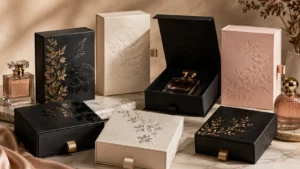
Short answer: Foil stamping, embossing, debossing, spot UV, lamination and magnetic closures are the finishing techniques most responsible for a premium look and feel. Each adds a different visual or tactile cue that shapes how luxurious the packaging appears.
- Foil stamping: Adds metallic shine to logos, text or patterns — instantly recognizable as a luxury cue.
- Embossing: Raises a design for a bold, dimensional, celebratory feel.
- Debossing: Presses a design inward for a quiet, refined, understated effect.
- Spot UV: Applies a glossy coating to specific areas, creating contrast against a matte background.
- Matte lamination: Gives a smooth, non-reflective, modern finish.
- Gloss lamination: Creates a bright, reflective, retail-ready shine.
- Soft-touch coating: Adds a velvety texture that feels premium to the touch.
- Metallic printing: Introduces shimmer or colour-shift effects across larger surfaces.
- Texture printing: Mimics leather, linen or wood grain for tactile interest.
- Ribbon closures: Add a decorative, gift-ready finishing detail.
- Magnetic closures: Provide secure, reusable, satisfying-to-open lids.
Combining two or three of these finishes — rather than all of them — usually produces the most elegant, cohesive result.
How to Choose Colours for Luxury Perfume Packaging
Short answer: Colour choice should reflect the fragrance’s personality and target audience. Black and gold suggest classic luxury, white and silver feel modern and clean, while pastels, earthy tones and jewel shades appeal to specific fragrance families and gender positioning.
Colour is one of the fastest signals a customer processes, often before they read a single word on the box.
- Black: Bold, mysterious, associated with premium and often masculine or unisex fragrances.
- White: Clean, minimal, modern — popular for fresh or floral scents.
- Gold: Classic luxury cue, works well as an accent on black, white or cream backgrounds.
- Silver: Sleek, contemporary, often used for modern unisex or masculine lines.
- Red: Passionate, bold, commonly used for evening or statement fragrances.
- Navy blue: Confident and sophisticated, popular for masculine and aquatic scents.
- Pastel colours: Soft, feminine, suited to floral or gourmand fragrances.
- Earthy shades: Warm, natural, aligned with woody or sustainable fragrance lines.
- Metallic accents: Add shimmer without overwhelming the primary colour palette.
Rather than choosing colour first, most successful brands start with the fragrance’s story and audience, then select a palette that reinforces it.
Typography and Branding Tips for Perfume Box Design
Short answer: Clear hierarchy, generous spacing, and consistent fonts across all packaging elements keep perfume boxes readable and premium. Logo placement should feel intentional, not crowded, and product information should stay legible without competing with the brand’s visual identity.
A few practical tips:
- Limit yourself to two typefaces — one for the logo or headline, one for supporting text.
- Keep font sizes for fragrance name and net volume legible from a normal viewing distance.
- Leave breathing room around the logo rather than placing it edge-to-edge.
- Keep typography consistent across the outer box, inner tray and any inserts.
- Position mandatory product information (volume, ingredients, batch code) neatly, without disrupting the main design.
How Custom Inserts Protect Perfume Bottles
Short answer: Custom inserts hold the glass bottle firmly in place, absorb shock during transit, and present the product neatly when the box is opened. The right insert material depends on the bottle’s shape, weight and the brand’s budget.
Glass bottles are fragile and often irregularly shaped, so a snug, well-designed insert is essential for both protection and presentation.
| Insert Type | Protection Level | Look & Feel | Best For |
| Foam insert | High | Functional, can be flocked or coloured | E-commerce shipping, fragile or heavy bottles |
| EVA insert | High | Firm, clean-cut edges | Retail and gift packaging needing a tidy finish |
| Cardboard insert | Medium | Structured, cost-effective | Standard bottle shapes, mid-range packaging |
| Moulded paper insert | Medium-High | Natural, eco-friendly texture | Sustainable and premium eco-conscious brands |
Foam and EVA inserts generally offer the highest protection for shipping, while moulded paper inserts are gaining popularity among brands prioritizing sustainability alongside presentation.
Sustainable Perfume Packaging Ideas for Luxury Brands
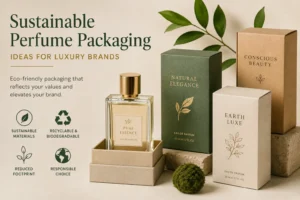
Short answer: Sustainable luxury perfume packaging is achievable through recyclable rigid boards, paper-based inserts, reduced plastic use and reusable box structures. These choices can maintain a premium appearance while lowering environmental impact.
Practical ways to make perfume packaging more sustainable without losing its premium feel:
- Choose FSC-certified or recycled rigid board instead of non-recyclable composite materials.
- Replace foam inserts with moulded paper or cardboard trays where bottle shape allows.
- Use paper ribbons or bands instead of plastic shrink wrap.
- Design boxes that customers can reuse for storage, adding perceived value beyond a single use.
- Choose water-based or soy-based inks and coatings over solvent-based alternatives.
- Reduce unnecessary layers of packaging while keeping adequate protection.
Organizations such as the Sustainable Packaging Coalition offer useful benchmarks for brands looking to evaluate the environmental footprint of their packaging choices.
Common Perfume Packaging Design Mistakes to Avoid
Even well-intentioned packaging projects can go wrong. Some of the most common mistakes include:
- Using weak or flimsy materials that dent or warp during shipping.
- Designing the box without first confirming exact bottle dimensions.
- Poorly fitted inserts that let the bottle shift or rattle inside the box.
- Overcrowding the design with too many finishes, colours or elements.
- Choosing decorative fonts that are difficult to read at small sizes.
- Inconsistent branding between the outer box, inner tray and inserts.
- Selecting expensive finishes without checking they fit the overall budget.
- Underestimating protection needed for transport and last-mile delivery.
- Relying heavily on plastic when paper-based alternatives would work just as well.
- Copying a competitor’s packaging too closely instead of building a distinct identity.
Avoiding these mistakes early — ideally at the prototype stage — saves both cost and rework later in production.
How to Choose a Perfume Packaging Box Manufacturer
Short answer: Evaluate a manufacturer’s customization capabilities, material quality, printing and finishing standards, prototype availability, minimum order quantity and delivery reliability before committing to a production run. Experience with rigid luxury boxes specifically is especially important.
Before selecting a perfume packaging box manufacturer, it’s worth checking:
- Customization capabilities — Can they support your specific box style, insert design and finishing choices?
- Material quality — Do they offer genuinely rigid, premium-grade board rather than thin substitutes?
- Printing quality — Is colour accuracy and print consistency reliable across runs?
- Structural design support — Can their team help refine or troubleshoot your box structure?
- Prototype and sample availability — Will they produce a physical sample before full production?
- Insert customization — Can inserts be precisely fitted to your bottle shape?
- Minimum order quantity — Does their MOQ match your current production scale?
- Production capacity — Can they handle your order size and any future growth?
- Quality control — What checks are in place before boxes are shipped?
- Delivery timelines — Are their lead times realistic and consistently met?
- Experience with luxury rigid boxes — Have they produced comparable premium packaging before?
Packology works with fragrance brands, cosmetic companies and private-label manufacturers to develop rigid perfume packaging tailored to brand identity, exact bottle dimensions and chosen finishing techniques — from prototype through to full production.
If you’re currently comparing custom perfume box manufacturers, it’s worth requesting samples from a few options before committing to a production run — the physical feel of a box often reveals quality differences that photos can’t show.
Ready to move forward? Get in touch with Packology’s packaging team to discuss your fragrance line and request a sample or quotation.
How Much Does Custom Perfume Packaging Cost?
Short answer: Custom perfume packaging cost depends on box style, dimensions, material thickness, printing complexity, chosen finishes, insert type, order quantity and any personalization. There’s no fixed price, since each of these factors shifts the total cost.
Rather than a flat rate, pricing is built from several variables:
- Box style — A simple two-piece box costs less than a magnetic-closure drawer box with multiple components.
- Dimensions — Larger boxes use more material and may affect shipping costs.
- Material thickness — Heavier rigid board costs more than standard paperboard.
- Printing — Multi-colour or full-coverage printing costs more than simple one- or two-colour designs.
- Finishing — Foil stamping, embossing and soft-touch lamination each add incremental cost.
- Insert type — Custom-fitted foam or EVA inserts cost more than a basic cardboard tray.
- Order quantity — Larger volumes generally lower the per-unit cost.
- Personalization — Individual naming or numbering adds production complexity.
- Prototype development — Sampling and structural testing before full production is often a separate cost.
Because these factors vary so widely from one brand to another, it’s best to request a customized quotation based on your specific box style, quantity and finishing requirements rather than relying on a general price estimate.
Conclusion
The right perfume packaging box design does far more than hold a bottle — it protects the product, reinforces brand identity, strengthens shelf presence and shapes the customer’s entire experience from first glance to final spray. Whether you’re drawn to a magnetic-closure rigid box, a velvet-lined drawer style, or a minimalist monochrome design, the details in material, insert and finishing choices are what turn good packaging into genuinely luxury packaging.
If you’re ready to bring one of these perfume packaging box design ideas to life, Packology’s team can help you develop custom rigid perfume boxes, branded inserts and premium finishing suited to your fragrance line — from initial concept and prototype through to full production. Reach out to Packology today to discuss your project and request a tailored quotation.
Frequently Asked Questions
Which material is used for luxury perfume boxes?
Rigid greyboard is the most common material for luxury perfume boxes, often wrapped in premium paper or textured stock for a refined finish.
How can perfume packaging look more luxurious?
Combining a rigid structure with finishes like foil stamping, embossing or soft-touch lamination, along with a well-fitted insert, makes packaging look significantly more luxurious.
Are rigid boxes suitable for perfume bottles?
Yes, rigid boxes are well suited to perfume bottles because their sturdy structure protects fragile glass while presenting the product in a premium way.
What inserts are used inside perfume packaging boxes?
Foam, EVA, cardboard and moulded paper inserts are commonly used to hold perfume bottles securely and prevent movement during transit.
Can perfume boxes be customized with a brand logo?
Yes, logos can be added through printing, foil stamping, embossing or debossing, depending on the level of branding emphasis a brand wants.
Is sustainable luxury perfume packaging possible?
Yes, recyclable rigid board, paper-based inserts and reduced plastic use can create sustainable packaging that still looks and feels premium.
What is the minimum order quantity for custom perfume boxes?
Minimum order quantities vary by manufacturer and box complexity, so it's best to confirm current MOQ directly with your chosen packaging partner.
How much does custom perfume packaging cost?
Cost depends on box style, materials, printing, finishing, inserts and order quantity, so pricing is typically provided through a customized quotation.
How do I choose a perfume packaging box manufacturer in India?
Look for a manufacturer with proven experience in rigid luxury boxes, strong printing and finishing quality, prototype support and reliable delivery timelines.